
Understanding math concepts matters more than most parents realize. A child who knows why 7 + 8 equals 15 can rebuild the answer even on a tired day. A child who only memorized the fact often freezes the moment the memory does not come fast enough. That is the real difference between understanding and memorizing, and it shapes confidence, speed, and long-term progress.
Memorization is not the villain here. Kids do need some facts at their fingertips. The problem starts when speed becomes the whole goal. Groups like the National Council of Teachers of Mathematics and the What Works Clearinghouse both point toward teaching that connects ideas, models, and discussion, not just repetition.
If homework at home keeps turning into tears, this shift is often the missing piece. Once children start seeing patterns, quantity, place value, and relationships between numbers, math stops feeling like a list of random rules. It starts making sense.
📺 Video Guide
Understanding math concepts gives children something to stand on
When kids understand a concept, they can explain it, model it, and apply it in a new situation. That is a much stronger signal than getting one worksheet right. For example, a child who understands subtraction with regrouping knows that one ten can be traded for ten ones. A child who memorized steps may know to “borrow” without any clue what is actually happening.
This matters because school math keeps stacking ideas. Place value becomes addition and subtraction strategies. Those become multiplication and division. Fractions build on equal parts, comparison, and number sense. If the early layers are shaky, later lessons feel confusing for reasons that are hard to spot. That is why resources from YouCubed, NAEYC, and the Education Endowment Foundation keep emphasizing reasoning, talk, and visual models.
You can see real understanding in the small moments. Your child solves 9 + 6 by saying, “I moved 1 from 6 to make 10, then 10 + 5.” Your child checks an answer and says, “That cannot be right because 4 groups of 6 should be bigger than 20.” Those comments tell you the brain is working with ideas, not just recall.
✓ Signs your child really understands
- ✓ They can explain the answer in their own words.
- ✓ They can solve the same problem in more than one way.
- ✓ They notice when an answer looks too big or too small.
- ✓ They can use drawings, objects, or number lines without being told.
Memorizing still matters, just not on its own
Parents often hear mixed messages here, so let us make it simple. Fluency matters. Children benefit from knowing number bonds, multiplication facts, and common fraction relationships without a long delay. But fluency grows best when it is built on meaning. The basic idea of number is not mechanical, and kids who connect facts to patterns usually remember them better anyway.
Think of memorization as compression. First your child works with pictures, counters, number lines, and verbal reasoning. Then the brain starts storing useful shortcuts. That is healthy. Trouble starts when we reverse the order and demand shortcuts before understanding exists. Kids may look fine for a week, then hit a word problem or a slightly unfamiliar exercise and crash.
This is one reason many families find that endless drilling does not solve the real problem. A page of repeated sums might produce temporary speed, but it does not automatically build number sense. If you want a better balance, pair fact practice with pattern spotting. Ask what the child notices. Ask how this problem is like another one. Ask how they know the answer makes sense.
Five ways to build understanding at home
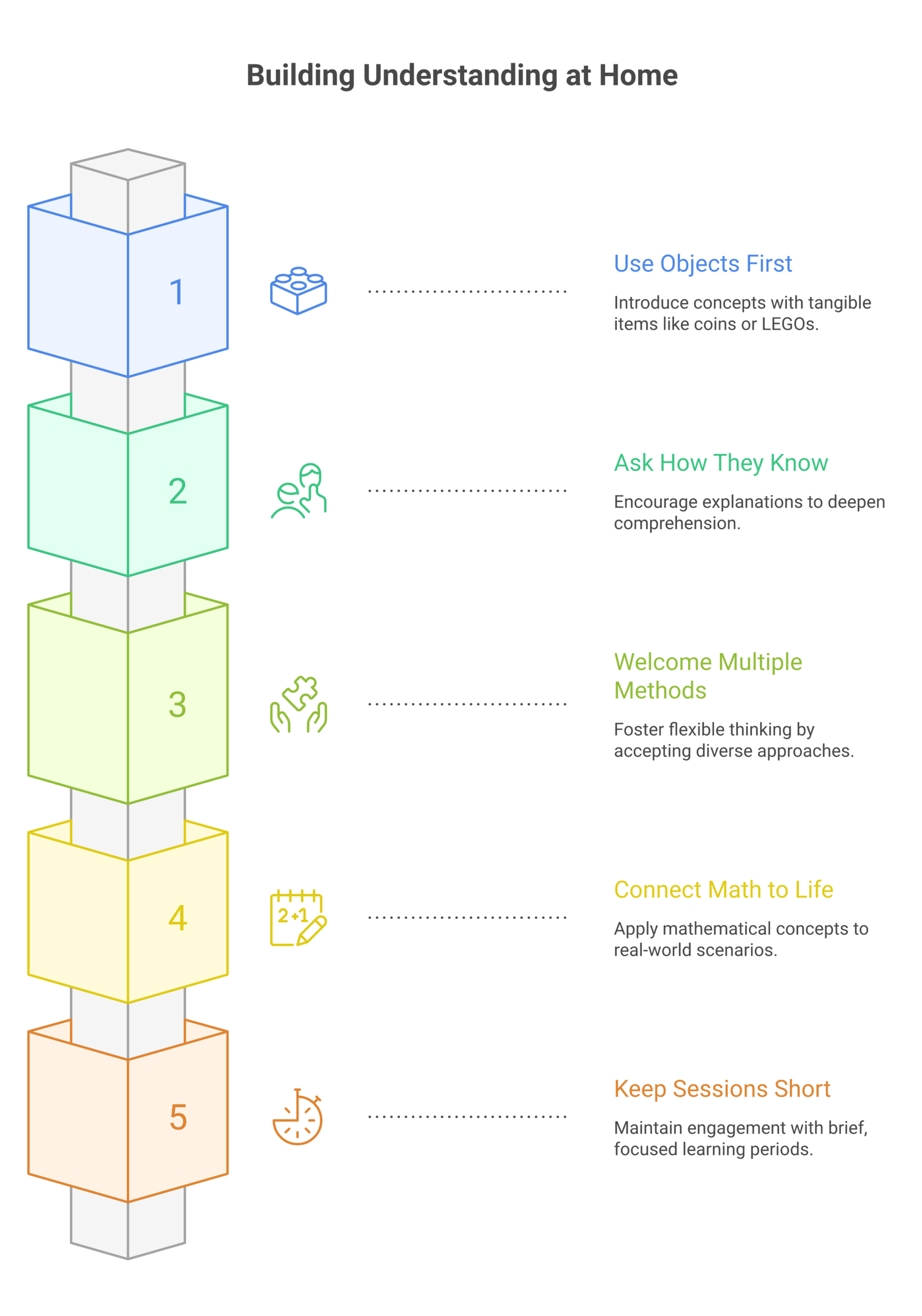
You do not need to be a teacher to help. You just need better prompts and a little patience. Here are five home strategies that work especially well.
1. Use objects before symbols. Coins, LEGO bricks, cards, and snacks are perfect for showing groups, equal parts, and comparison. Concrete objects make abstract ideas less slippery.
2. Ask “how did you know?” more than “what is the answer?” That one question slows the rush to guess and turns math into reasoning.
3. Encourage more than one method. If your child solves 36 + 19 by adding 20 and then subtracting 1, celebrate it. Flexible thinking is a great sign.
4. Connect math to real life. Cooking, shopping, travel time, and sports all create natural chances to compare, estimate, and measure. The NRICH project and Khan Academy both offer ideas that keep practice grounded in meaning.
5. Keep practice short and frequent. Ten calm minutes beats one long battle. Short sessions protect confidence and help children stay mentally available for thinking.
💡 Pro Tip
If your child gets stuck, do not rescue too fast. Ask them to draw it, show it with objects, or estimate first. That small pause often brings the concept back.
Worksheets can help if they are used the right way
Worksheets are useful when they support a clear idea instead of just testing recall. A good worksheet sequence starts with visual models, moves to guided examples, then shifts to independent practice. That structure gives children a path. A random page of twenty disconnected questions usually does not.
This is exactly where a tool like MathSpark can help. If you need fresh practice that matches your child’s level without turning homework into a full family event, MathSpark generates age-appropriate math worksheets in about 10 seconds. It follows the Pythagoras Exams methodology and works well when you want targeted practice on one idea, such as place value, regrouping, fractions, or multiplication strategies.
The key is how you use the page. Sit with the first few questions. Ask your child what they notice. Let them talk through one example. Then step back. If a worksheet becomes a pure race, it stops serving understanding. If it becomes a conversation starter, it is doing its job.
Research summaries from Edutopia, the OECD PISA programme, and guides for parents at Understood keep landing in the same place: children need explanation, representation, and feedback, not only speed.
Questions that uncover whether the idea is there
You can learn more from three minutes of conversation than from a whole page marked correct. Try questions like these when your child finishes a problem.
“Can you show that another way?”
“What would happen if the numbers were bigger?”
“Which part was easy, and which part felt weird?”
“How do you know your answer is reasonable?”
“Could you explain this to a younger child?”
These prompts work because they reveal whether the child is holding a rule or a concept. If the explanation collapses immediately, the foundation probably needs more concrete work. If the child can adjust, compare, and justify, that is progress worth trusting.
If homework is still tense, these related guides on help with math homework without stress, growth mindset helps kids learn math, and problem-solving strategies for kids are worth keeping nearby.
📝 Important Note
A child who counts on fingers or draws pictures is not necessarily behind. Often that is exactly how understanding is forming. The goal is not to remove strategies too early. The goal is to help those strategies become more efficient over time.
What progress looks like in real life
Parents sometimes miss progress because it does not always look like speed. Real growth often sounds like better questions, calmer problem solving, and fewer random guesses. Your child starts correcting their own mistakes. They notice that 398 + 205 should be just over 600 before they calculate it exactly. They connect today’s lesson to something from last month.
That kind of progress usually lasts longer than memorized tricks. It is also more useful when school raises the difficulty. Whether your child is working through understanding place value, reviewing common math mistakes kids make, or preparing for a new unit, the same principle holds: build meaning first, then fluency.
So if you are deciding where to put your energy this month, put it into understanding math concepts. Memorization can sit on top of that later. The order matters. Get the sense-making right, and a lot of the stress starts to loosen its grip.
⚠️ Disclaimer
This article is for general educational support and reflects common parent guidance as of April 2026. It does not replace advice from your child’s teacher or school support team, especially if your child has persistent learning difficulties or needs a formal assessment.
Frequently Asked Questions
Should my child memorize math facts or understand concepts first?
Understanding should come first. Memorization becomes more stable when children know what the numbers mean and how the operations work.
How can I tell if my child really understands a math idea?
Ask them to explain the answer, draw it, or solve it in another way. If they can justify their thinking, the concept is likely there.
Are worksheets bad for conceptual understanding?
No. Worksheets help when they target one idea clearly and are used with discussion, models, and feedback. They become less helpful when they only push speed.
What should I do if homework turns into a fight?
Shorten the session, go back to concrete examples, and ask thinking questions instead of pushing for fast answers. Calm, targeted practice is usually more effective than a long argument.