
Πρακτικός οδηγός για γονείς
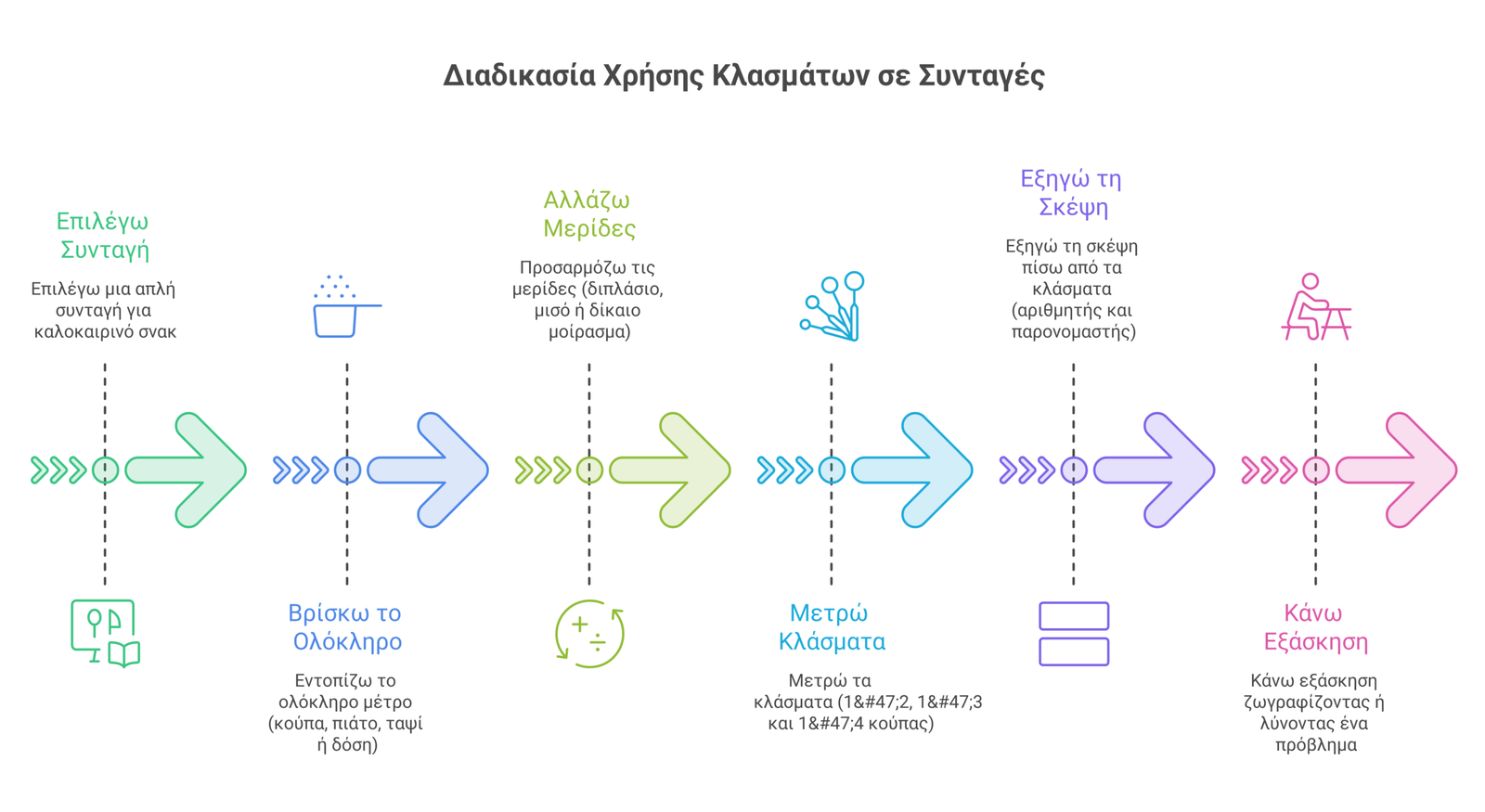
Οι διασκεδαστικές δραστηριότητες με κλάσματα χρησιμοποιώντας καλοκαιρινά σνακ και συνταγές βοηθούν το παιδί να καταλάβει τα μαθηματικά χωρίς ένταση. Όταν το παιδί κόβει μια πίτα σε τέσσερα ίσα μέρη, γεμίζει μια μεζούρα 1/4 ή μοιράζει φρούτα σε φίλους, δεν αποστηθίζει απλώς κανόνες. Βλέπει τι σημαίνει ολόκληρο, τι σημαίνει ίσο μέρος και γιατί δύο τέταρτα μπορούν να είναι το ίδιο με ένα δεύτερο.
Η κουζίνα είναι ασφαλής χώρος για λάθη. Αν μια φέτα βγει μεγαλύτερη, μπορείτε να μιλήσετε για δικαιοσύνη. Αν η συνταγή θέλει μισή κούπα και έχετε μόνο τέταρτα, μπορείτε να μετρήσετε δύο τέταρτα. Αν έρχονται περισσότερα παιδιά για παιχνίδι, μπορείτε να διπλασιάσετε τη συνταγή και να δείτε πώς αλλάζουν οι ποσότητες. Αυτή η ήρεμη, πρακτική εμπειρία είναι συχνά πιο δυνατή από μια σελίδα ασκήσεων.
Μετά τη δραστηριότητα, μια σύντομη εξάσκηση σε χαρτί βοηθά να σταθεροποιηθεί η γνώση. Το MathSpark μπορεί να δημιουργήσει γρήγορα φύλλα εργασίας προσαρμοσμένα στο επίπεδο του παιδιού, ώστε η πρακτική εμπειρία να συνδεθεί με σύμβολα, αριθμητές, παρονομαστές και απλά προβλήματα λέξεων.
Διασκεδαστικές δραστηριότητες με κλάσματα στην κουζίνα
Οι διασκεδαστικές δραστηριότητες με κλάσματα γίνονται πιο εύκολες όταν το παιδί βλέπει, αγγίζει, χωρίζει και δοκιμάζει το ολόκληρο. Ένα μπολ με φρούτα, μια φέτα καρπούζι, μια πίτα ή μια απλή συνταγή για smoothie μετατρέπει τον αριθμητή και τον παρονομαστή σε κάτι χειροπιαστό. That matters because the Common Core fraction standards introduce fractions as equal parts of a whole and as numbers that can be placed on a number line, not just symbols to memorize.
Για τους γονείς, τα καλοκαιρινά σνακ είναι ιδανικά γιατί υπάρχουν ήδη στην καθημερινότητα. You do not need a formal lesson, special manipulatives, or a dramatic kitchen project. You need one whole item, equal parts, a few questions, and a calm pace. This approach also matches the practical spirit behind MathSpark at MathSpark, where quick AI-generated worksheets help children practice the same ideas after they have explored them with real objects.
Ο στόχος δεν είναι να γίνει το μεσημεριανό μάθημα. The goal is to make math feel useful. When children halve a sandwich, split grapes into fourths, or double a smoothie recipe, they learn that fractions answer real questions: How much is fair? How many scoops make one cup? What changes when we make twice as much? If your family is already using summer math skills, snack-based fraction practice is a natural next step.
✓ Βασικά οφέλη
- ✓ Children see equal parts before writing symbols.
- ✓ Parents can practice for ten minutes without a worksheet battle.
- ✓ Recipes naturally connect fractions, measurement, and problem solving.
📺 Video Guide
Το πιάτο πικνίκ με κλάσματα
Start with a picnic plate divided into four zones: fruit, crackers, cheese, and one treat. Ask your child to build a plate where one half is fruit, one quarter is crackers, and one quarter is cheese. Then change the challenge: make three quarters healthy foods, make one eighth a treat, or show two fourths in a different way. This is a simple region model, the same kind of model recommended by many math educators including NCTM.
Keep the language precise but friendly. Say, “The denominator tells us how many equal parts the whole has. The numerator tells us how many parts we are talking about.” Then point to the plate. If the plate has four equal zones and two are fruit, the child can see why two fourths equals one half. Britannica gives the formal definition of a fraction, but the plate gives the child a memory that sticks.
For younger children, stop at halves and quarters. For grades 3 and 4, compare one half, two fourths, and four eighths. For older children, ask them to design a plate for two people and explain how the fractions change when the whole changes. Link the activity later to real-life math activities so the child sees that grocery shopping, cooking, and sharing are all math situations.
Καρπούζι, πίτσα και ίσα μέρη
Round foods are fraction gold. A watermelon wheel, pita, tortilla, pancake, or pizza lets children test one of the biggest fraction rules: the parts must be equal. Cut one circle into messy pieces first and ask if each person received one quarter. Most children immediately notice the unfairness. Then cut another circle carefully into equal quarters and compare. That contrast teaches more than a definition copied from a textbook.
Use a summer pizza activity even if it is only a tortilla with tomato and cheese. Divide it into halves, then quarters, then eighths. Ask, “Which piece is larger, one half or one eighth?” Children often think eight is bigger because eight is a bigger whole number. The visual model corrects that misconception gently. Resources such as Education.com recipe fractions and Nomster Chef use recipes for exactly this reason: the context gives children something real to reason about.
Once your child is comfortable, introduce equivalent fractions. Put two eighths next to one quarter. Put four eighths next to one half. Let the child say what they notice before you write 2/8 = 1/4 or 4/8 = 1/2. This mirrors the progression in many grade-level standards and keeps the work low-pressure. If your child needs follow-up practice, generate a short MathSpark worksheet with visual fraction models rather than jumping straight into long written exercises.
Προκλήσεις με μεζούρες
Measuring cups are one of the best tools for fun fraction activities because they combine a part-whole model with measurement. Give your child a 1/4-cup scoop and a clear 1-cup container. Ask how many scoops will fill the whole cup. Let them predict, test, count, and say the equation aloud: one quarter plus one quarter plus one quarter plus one quarter equals one whole.
Then repeat with a 1/2-cup scoop and a 1/3-cup scoop. The repeated action helps children understand unit fractions. It also prepares them for multiplication later because four scoops of one quarter can be written as 4 × 1/4. Khan Academy fractions has strong practice for fraction arithmetic, but the measuring cup activity gives children the concrete foundation they need before online practice becomes useful.
For grades 5 and above, use a recipe card. If the smoothie needs 1 1/2 cups of yogurt and the only scoop is 1/2 cup, how many scoops are needed? If a lemonade recipe uses 3/4 cup of juice and you double it, what is the new amount? These problems feel less threatening because the child is solving for a snack, not performing for a grade.
Διπλασιάστε ή μισέψτε μια καλοκαιρινή συνταγή
Choose one simple recipe: yogurt parfaits, fruit salad, lemonade, pancakes, trail mix, or no-bake oat balls. Write the original amounts on a card. Then ask your child to make a half batch or a double batch. This turns fractions into decisions. Half of 1/2 cup is 1/4 cup. Double 3/4 cup is 1 1/2 cups. A child who can physically measure the result is more likely to trust the math.
Recipe scaling is also a natural bridge to proportional reasoning. If the recipe serves four people and six cousins arrive, the question becomes practical: how can we make enough without wasting food? The OISE University of Toronto has published classroom reflections on teaching fractions through baking, and the same principle works at home. Children remember the moment they adjusted a recipe because the math changed something real.
Parents can keep this simple with a three-column table: original amount, new amount, and how we know. Encourage drawings. A child can sketch measuring cups, fruit pieces, or number lines. The table can become a worksheet later, especially if you pair it with printable summer math worksheets for a quiet ten-minute practice session after the kitchen activity.
💡 Πρακτική συμβουλή
Ask your child to explain the fraction with words before writing the equation. Explanation is where the real learning shows up.
Προσαρμογές ανά τάξη
For kindergarten through grade 2, use language and sorting. Say half, whole, equal, more, less, share, and fair. Cut fruit into two or four pieces and compare. Avoid heavy notation unless your child asks for it. At this age, the win is comfort: fractions are not scary; they are just fair shares and pieces of a whole.
For grades 3 and 4, connect the activity to numerator, denominator, equivalent fractions, and comparisons. The official Common Core fraction standards emphasize denominators such as 2, 3, 4, 6, and 8 in grade 3, so watermelon eighths, tortilla quarters, and cup thirds are useful choices. Children can record equations, draw models, and compare fractions with the same denominator or numerator.
For grades 5 to 8, move into operations and ratios. Ask your child to scale recipes, compare sugar-to-flour ratios, convert improper fractions to mixed numbers, or design a recipe for a different number of servings. National Numeracy and Understood both stress confidence and everyday numeracy, which is exactly what these small kitchen tasks build.
Μια ήρεμη ρουτίνα δέκα λεπτών
Use this routine when you want practice without a meltdown. Minute one: choose the snack and the target fraction. Minutes two to four: build or cut the model. Minutes five to seven: ask two questions, such as “What fraction is fruit?” and “Can you show the same amount another way?” Minutes eight to ten: write one equation or draw one picture. Stop there, even if it went well.
The stopping point matters. Parents often stretch a good learning moment until the child gets tired. Keep it short so the child wants to try again tomorrow. If you want written reinforcement, use MathSpark to create a quick worksheet at the same level. That gives you continuity without turning the snack table into a lecture.
You can rotate the routine through the week: fruit fractions on Monday, measuring cups on Tuesday, recipe scaling on Wednesday, pizza pieces on Thursday, and a mini word problem on Friday. Pair it with prevent summer math slide if your goal is preventing summer math slide, and use shape hunts and patterns when younger learners need pattern and sorting work before formal fractions.
📝 Σημαντική σημείωση
Use equal parts whenever you name a fraction. Unequal slices are useful for discussing fairness, but they should not be labeled as true halves, thirds, or quarters.
Τι να πείτε όταν το παιδί κολλάει
If your child says fractions are confusing, do not start with a rule. Start with the whole. Ask, “What is the whole in this problem?” A whole can be one watermelon slice, one cup, one tray, one recipe, or one group of crackers. Many mistakes happen because the child changes the whole without noticing.
Next, ask what each equal part is called. If the whole is cut into eight equal pieces, each piece is one eighth. If the child has three pieces, the amount is three eighths. This language sounds basic, but it prevents the common habit of treating the numerator and denominator as two unrelated whole numbers.
Finally, ask for a drawing or a physical model. Research-informed resources such as NASA Space Place and PBS LearningMedia keep returning to visuals because they reduce working memory pressure. A child who can build the fraction is much closer to writing it correctly.
⚠️ Σημείωση
This June 2026 guide is educational advice for home practice. If your child has persistent difficulty with number sense, reading math language, or anxiety around schoolwork, consider speaking with their teacher or a qualified learning specialist.
Συχνές ερωτήσεις
Ποια ηλικία είναι κατάλληλη για δραστηριότητες με σνακ;
Children can begin with halves and quarters in early primary school, then move into equivalent fractions and recipe scaling from grades 3 to 5.
Χρειάζονται ειδικά υλικά;
No. Fruit, crackers, tortillas, measuring cups, paper plates, and a pencil are enough for most activities.
Πόσο πρέπει να διαρκεί μια εξάσκηση στο σπίτι;
Ten to fifteen minutes is plenty. Short, repeated practice usually works better than one long session.
Να διορθώνω κάθε λάθος αμέσως;
Correct the model first. Ask your child to rebuild the whole, check equal parts, and explain what the numerator and denominator mean.
Πώς βοηθά το MathSpark μετά τη δραστηριότητα?
Use MathSpark to generate a matching worksheet so your child practices the same fraction idea independently after seeing it in real life.
Πώς να το εφαρμόσετε όλη την εβδομάδα
Τη Δευτέρα δουλέψτε με φρούτα: μισά μήλα, τέταρτα καρπουζιού, οκτάδες πορτοκαλιού. Την Τρίτη δουλέψτε με μεζούρες: πόσα 1/4 χρειάζονται για μία κούπα, πόσα 1/2 για μιάμιση κούπα, πόσα 1/3 για ένα ολόκληρο. Την Τετάρτη χρησιμοποιήστε μια συνταγή για γιαούρτι με φρούτα και ζητήστε από το παιδί να φτιάξει μισή ποσότητα. Την Πέμπτη κάντε σύγκριση: ποιο είναι μεγαλύτερο, 1/2 ή 3/8; Την Παρασκευή γράψτε μαζί ένα μικρό πρόβλημα από την πραγματική ζωή.
Να θυμάστε ότι ο παρονομαστής δεν είναι απλώς ο κάτω αριθμός. Είναι ο αριθμός των ίσων μερών στο ολόκληρο. Ο αριθμητής δεν είναι απλώς ο πάνω αριθμός. Είναι πόσα από αυτά τα ίσα μέρη μας ενδιαφέρουν. Αν το παιδί μπορεί να το πει με λόγια, να το δείξει με φαγητό και μετά να το γράψει ως κλάσμα, έχει κάνει τρία σημαντικά βήματα κατανόησης.
Για παιδιά που αγχώνονται, κρατήστε τις δραστηριότητες μικρές. Δέκα λεπτά αρκούν. Μην διορθώνετε με αυστηρότητα. Ρωτήστε: ποιο είναι το ολόκληρο; Είναι ίσα τα κομμάτια; Πόσα κομμάτια έχουμε συνολικά; Πόσα κομμάτια μετράμε; Αυτές οι ερωτήσεις οδηγούν το παιδί στη σωστή σκέψη χωρίς να νιώθει ότι εξετάζεται.